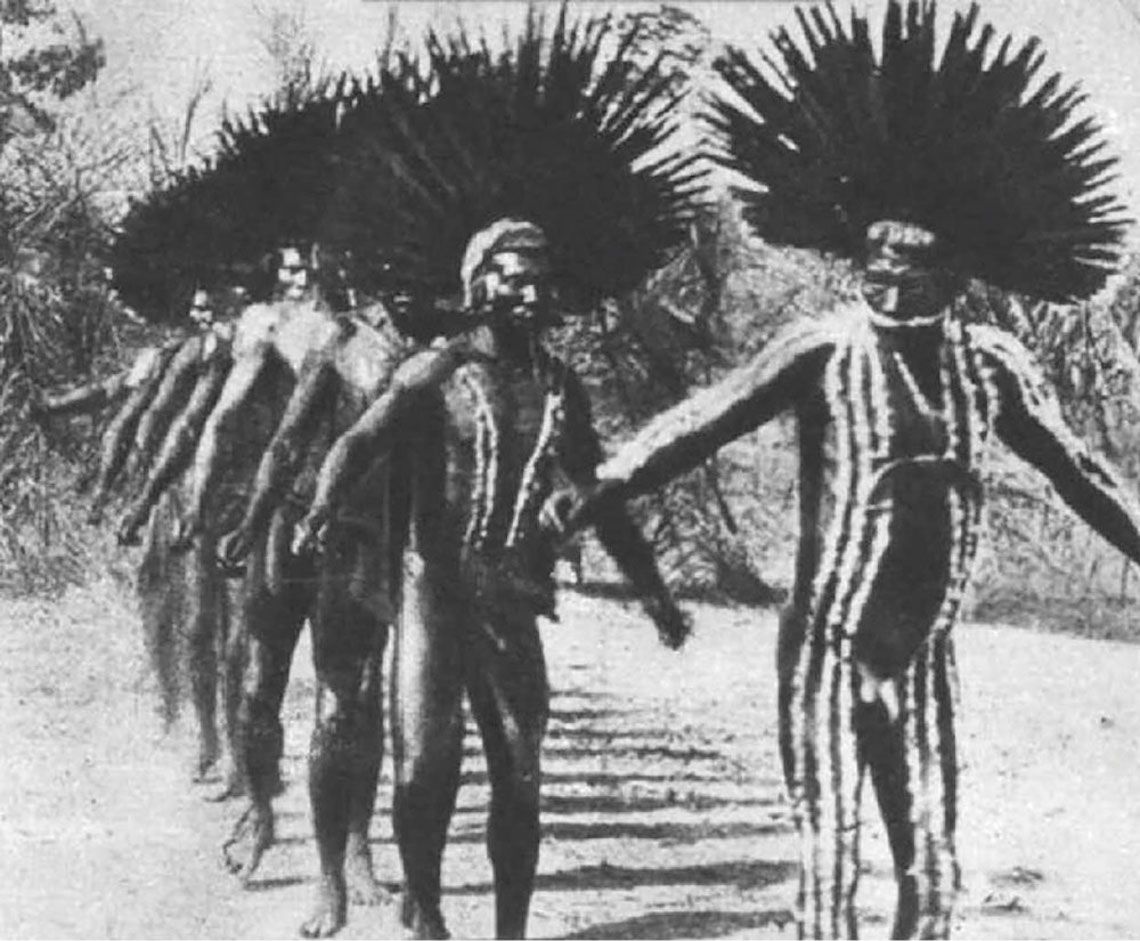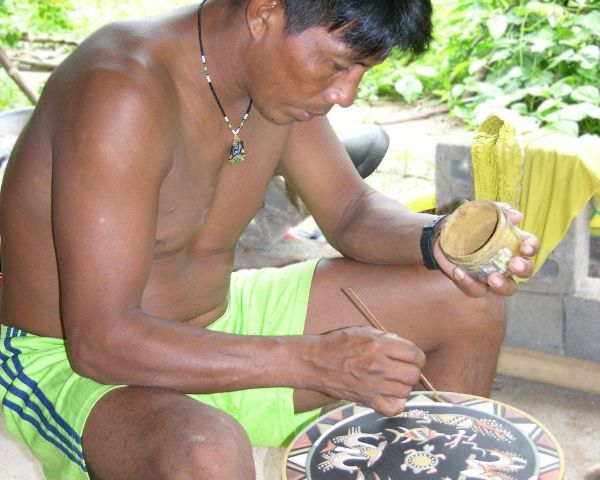
Although it is well known that South American Lowlands Indigenous peoples have a remarkably sophisticated material life (Santos Granero 2009; Miller 2019), few recent studies have explicitly focused on the subject. Likewise, despite a surge in research volume, descriptions emphasizing affinity-based relationships overshadow those focused on descent relations (either between humans or with mythical ancestors). This project aims to contribute to discussions on the region's diverse object regimes, emphasizing ritual contexts where the creation of ornaments, musical instruments, and other artifacts handed down from one generation to the next is directly tied to more vertical relations or the "recapitulation of the development of the ancestral stock" (Goldman, 2004, p. 186). Focusing on life-cycle rituals among the Cubeo in Northwest Amazon and Bororo in Central Brazil – whose study can be considered as constitutive of South Americanist anthropology (Lévi-Strauss 1936; Goldman 1968) and who both figure among the very rare true segmentary societies of Lowland South America (Viveiros de Castro 1996, p.188),– our project stands out by shifting attention to nomination and male initiation as key to intergenerational transmission, in order to shed new light on Amazonian ritual paraphernalia and the history of Anthropology.

Participants :

Philippe Erikson

Maria Luisa Lucas

Manon Hias

Pedro Almeida Meniconi


Le projet dik@ré se propose d’offrir une base de données lexicales numériques de la langue yurakaré, une langue isolée d’Amazonie bolivienne à l’Institut de langue et culture yurakaré (ILC-Y) antenne locale de l’Institut plurinational des langues et cultures (IPLC) rattaché au ministère de l’Éducation en Bolivie. Il a pour contexte un groupe amazonien qui, d’un côté, abandonne sa langue pour l’espagnol, mais, de l’autre, est soutenu par une politique étatique de promotion identitaire et de préservation linguistico-culturelle. Fruit d’un réseau de collaborations internationales unissant des locuteurs de la langue et des chercheurs (deux linguistes et un anthropologue), il se propose de produire un dictionnaire papier, un dictionnaire en ligne ainsi que la base de données lexicales numériques qui permettra à l’ILC-Y de poursuivre l’étude et la promotion de la langue. Outre sa dimension collaborative, son engagement vis-à-vis de la restitution des données de la recherche, il inclut également un volet critique et réflexif qui permettra de questionner les politiques culturelles et linguistiques de l'Etat plurinational de Bolivie, les idéologies linguistiques qui s'y redefinissent et  l'appropriation par les autochtones du numérique.

Partenaires financeurs hors MSH Mondes

Awesome Foundation
Foundation for endangered languages
ERC SAPPHIRE

Collaborateurs

Gerónimo Ballivían, La Misión, río Chaparé
Ascencio Chávez, Nueva Galilea, río Chaparé
Alina Flores, San Pablo, río Isiboro
Rufino Yabeta, Nueva Lacea, río Sécure
Germán Maldonado, coordinateur, ILC-Y, Chimoré
Mercy Noe, ILC-Y, Chimoré
Daniel Chávez, ILC-Y, Chimoré
Mónica Yabeta, ILC-Y, Trinidad
Julen Villarreal Moreno, Leiden University
Rik van Gijn, Leiden University
Valentin Chabaux, MSH-Mondes
Vincent Hirtzel, Erea-Lesc, CNRS


Image1

Germán Maldonado, Mercy Noe et Daniel Ballivían, ILC-Yurakaré, Chimoré / V. Hirtzel, 2024.

DEBTCHAINS project explores the crafting of financialization of capitalism through a transnational and transcalar study of debt chains across licit and illicit markets. The growing concern about the financialization of capitalism has only focused on the tip of a financial iceberg. The submerged part is immense, and includes extremely profitable informal, illegal, and illicit financial markets, nowadays connecting to formal global finance. Today, the spread of financial, criminal, and political entanglements transcends State borders, established democracies, and lawful economies, and reaches into the core of legal and financial markets through activities such as extraction, consumption, and money laundering. Yet, systematic research on the links between finance in illegal economies, informal loans, microcredit, and Public Debt and formal banking systems are currently lacking. Exploring this invisible part of financialisation is crucial if we are to understand the contemporary dynamics of societies and social and economic inequalities.

DEBTCHAINS explores how financialization of capitalism, as a relational mode of economic accumulation, is sustained by chains of micro and macro debt which are shaped by and constitutive of flows of legalities and illegalities, of visibilities and invisibilities which both cross and segments markets, actors and financial practices. This project moves beyond abstract, disembodied, and technical approaches to financialization by turning it into a tangible object of empirical investigation through the prism of debt chains as constructed by a myriad of concrete actors. We consider that the financialization of capital is socially grounded, embedded in practices, and in various figures who build up those chains of debts. We will follow actors tied together by debts in three markets we already have a privileged access through our past research - one illegal product, cocaine between Brazil and France; two legal products (wood and pesticides) in India embedded within regional and global criminal political economies.

By exploring the transnational chains of debts ethnographically across the global South and the global North, by connecting the debt practices of working-class families and communities with those of global financial institutions, we will focus on three main processes which operate across the segmented chains of debts. 1/ assembling: how do protagonists assemble licit and illicit actors and institutions to shape their own conducive socio-political and moral environments for sustaining their activities? ; guaranteeing debts: how are articulated the pluri-legal and illegal methods of regulation, guarantees, and enforcement used by both private and public institutions and the individuals associated with them? ; Converting money and goods: how do actors manage visibility and invisibility, legalities and illegalities, anonymity and denunciations, secrecy and public display of fortunes to convert money and goods into varied tangible and intangible assets ?

The project draws on a performative combination of disciplines (anthropology, sociology, economics, and political sociology), skills and expertise by bringing together specialists both in banking and financial regulation and informal and criminal economies to investigate the everyday making of financialization and the ways it reframes inequalities under financial capitalism.

MEMBRES

David Picherit, CNRS - LESC (PI)

Anthony Amicelle, Sciences Po Bordeaux, Centre Emile Durkheim
Hélène Ducourant, Université Gustave Eiffel
Gabriel Feltran, Sciences Po - CEE
Isabelle Guérin, IRD - CESSMA
Jeanne Lazarus, Sciences Po - CSO
Benjamin Lemoine, CNRS - CMH-ENS

Timothée Narring, IRD- CESSMA

Leandro Ramos De Castro, Post doc Debtchains, IRD-Cessma

POSTDOC OFFER OPEN - 18 months - Start: October 15th, 2025

Indigenous knowledges are crucial for coping with current global crises, such as climate change, loss of biocultural diversity and rise of xenophobic nationalisms. This pivotal historical moment requires multi-centred thinking and action, bringing together the multiplicity of Indigenous and academic expertise. Universities and academia are critically important in developing knowledge, education, and policy directives. Consequently, EDGES adopts those significant arenas to respectfully advance innovative, collaborative methodologies and new strategies for the entanglement of Indigenous knowledges in research, teaching and policy-making institutions. While there have been efforts to foster dialogue with Indigenous knowledges, these experiences remain elusive, local and not structurally transformative, as the shortcomings of multiculturalism and interculturality have demonstrated. How can we question the existing frameworks and develop new and effective entanglements of knowledges that draw from different epistemologies?

EDGES addresses this question through six different analytical layers with the significant participation of Indigenous academic researchers and the active collaboration of Indigenous intellectuals and experts. To accomplish this endeavour, EDGES creates a future sustainable and disciplinary diverse network of more than 150 researchers from 18 European and American universities, one SME and one NGO. The project contributes to a pluralist and multi-scale approach to knowledge production, research and dissemination through symposiums, workshops, mini-courses, open-access scientific publications, policy recommendations and social media. It will provide critical tools for universities, schools and communities to foster critical dialogue with Indigenous peoples and other cultural minorities by entangling Indigenous knowledges into university curricula and praxis, contributing to the education of future generations, improving policies and science renewal.

Les membres du LESC impliqués collaborent à divers axes du projet et sont co-responsables de l'axe (workpage) Promoting Indigenous Theories, Methodologies and Languages in the Renewal of Science and Education.

Cookies user preferences
We use cookies to ensure you to get the best experience on our website. If you decline the use of cookies, this website may not function as expected.
Accept all
Decline all
Flexicontent
Flexicontent
Accept
Decline
Save