Cold War Soundscapes - Musical Censorship and Aesthetic Agendas in Radio Tirana's Sound Archives, Eckehard Pistrick
Séminaire du CREM


Monday 16 October 2017 14:00 - 16:00
Lesc – salle 308F (3e étage)
21, allée de l’Université, Nanterre Présentation
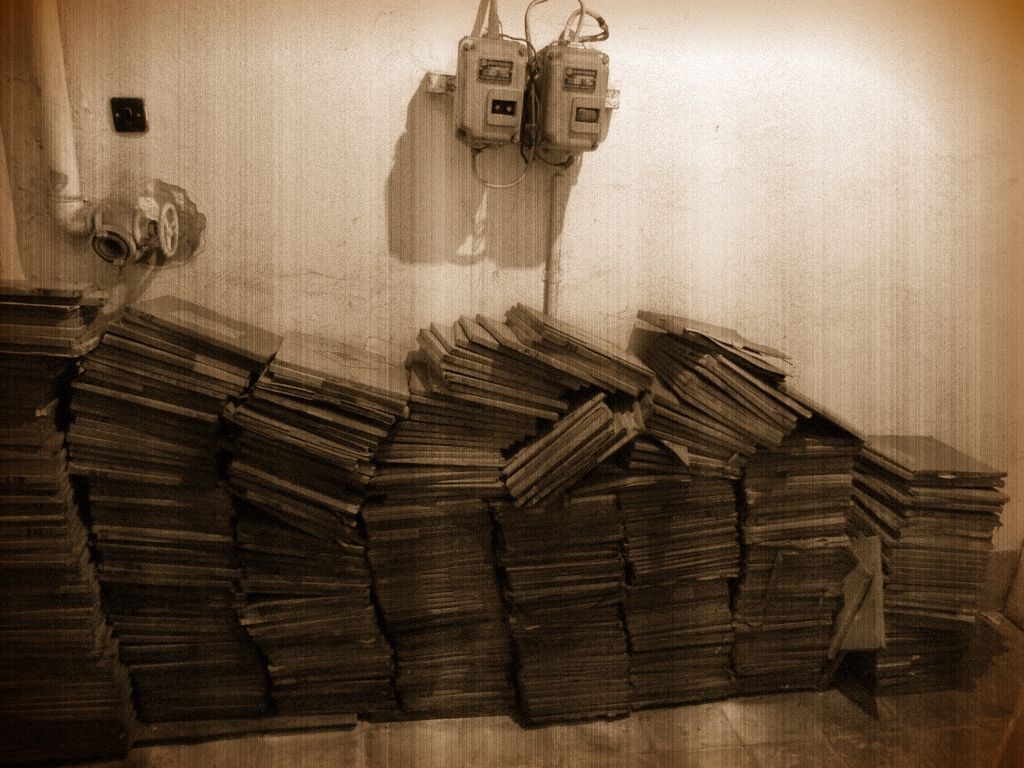 The presentation examines through a sound studies perspective one of the oldest broadcasting archives in Europe, founded in 1938. It particularly focuses on the taxonomy of a "Cold War Archive" and its ideological implications rooted in a vague and arbitrarily applied notion of "socialist realism". It will as well present first hand sources about how musical censorship on different levels (music aesthetics, textual, biographical) was applied on archived sound sources and what visual codes were used to denounce exclusion and defamation of musical works or artists. In a second part the talk will highlight the artistic potential of such sound archives, introducing my artistic collaboration with the Soundwalk Collective on censored sounds, as well as silences and absences in the archive.
  The CREM (Centre for Research in Ethnomusicology) seminar takes place on two Mondays per month, from 10:00 to 12:00. Members of the CREM (doctoral students included) and invited researchers present their ongoing work. The presentations last 50 minutes, and are followed by a coffee break and discussion hour.
Occasionally, the seminar takes the form of a workshop which brings together several researchers around a common theme. In these cases, the seminar takes place over an afternoon, or sometimes an entire day.
Participation in the seminar is open to everyone. It is also integrated into the Master’s degree in ethnomusicology at the Universities of Paris Nanterre and Paris Saint-Denis.
Calendrier 2025-2026
10 Oct 2025 : Créativités dansées
07 Nov 2025 : Créolisations musicales avec Denis-Constant Martin, Aurélie Helmlinger et Nicolas Prévôt
05 Dec 2025 : Peut-on filmer le sens musical ?
20 Feb 2026 : [Annulé] Séminaire du CREM
27 Mar 2026 : La vie sociale des instruments de musique : rencontre-projection-concert autour d'un bala du musée du quai Branly
24 Apr 2026 : World Amplification International Study Day
Calendrier 2024-2025
23 Sep 2024 : « Faire parler » l’invisible dans l’ombwiri. Une polyphonie de vocalités (Libreville, Gabon), Véronique Truffot
21 Oct 2024 : Danser avec son téléphone : le smartphone comme outil chorégraphique chez les krumpeurs de Dakar, Mahalia Lassibille
18 Nov 2024 : Carried by the Winds of Love: On Vocal Celebrity and the Mediation of Intimacy in Somaliland, Christina Woolner
02 Dec 2024 : Vocalités performatives
20 Jan 2025 : Instruire le geste instrumental : une enquête langagière sur les consignes en musique contemporaine, Arsène Caens
03 Feb 2025 : Gendered Dependence: Non-Binary Notions of Sexuality in Indian Art and Performance, Ann David
17 Mar 2025 : Trajectoire musicale et sociale d’un “mestre” de maracatu et de coco (Igarassu, PE, Brésil), avec Jean-Pierre Estival
31 Mar 2025 : ANNULÉ Séminaire du CREM, Mélissa Scott
Calendrier 2023-2024
18 Sep 2023 : Musique, danse, envie et « corps fermé » dans le Maracatu de baque solto du Pernambouc — Brésil, F. Bonini Baraldi
06 Nov 2023 : Elina Seye — African music and dance in Finland: transcultural contacts and collaborations
20 Nov 2023 : Laura Steil — Les bals face à l’usine. Enquête sur les festivités d’un quartier ouvrier luxembourgeois
04 Dec 2023 : Les fins du silence: la mémoire du génocide et les rôles commémoratifs des musiciens manouches
15 Jan 2024 : L'hybridité et les musiques du monde : questionnements à partir du cas de Charles Kely Zana-Rotsy et l'open gasy
29 Jan 2024 : New social dances for a new socialist life: East German experiments on the dance floor, 1951-1976, S. Hutchinson
12 Feb 2024 : Mettre en mouvement, tisser des liens : une anthropologie de deux scènes DJ à Accra (Ghana), Laure Carbonnel
Calendrier 2022-2023
19 Sep 2022 : Cosmologies of musical health practices
21 Nov 2022 : Paredões : entre des garages et des "bailes", les murs de haut-parleurs véhiculaires à São Paulo, Brésil
05 Dec 2022 : « Roukasskass », « concepts », vidéos et réseaux sociaux. Ethnographie du monde des danses urbaines à Abidjan (Côte d’Ivoire)
Calendrier 2021-2022
20 Sep 2021 : SYNCHRO, PAS SYNCHRO ? Questionnement à partir de quelques exemples de musiques superposées de l’Inde centrale
04 Oct 2021 : « Tak tun tuang », low style et camions de procession - Naissance, vie et mort d’un hit en Thaïlande
18 Oct 2021 : Conjuguer le passé au présent : La fête de compagnie et ses protagonistes sur l'île de Chios (Grèce, Nord-Est Egéen)
22 Nov 2021 : 4'33'' : le tuning sous réécoute
22 Nov 2021 : Le press agrume est dans la brouette
14 Feb 2022 : Hétérogénéité, induction sensible et mise en difficulté : des stratégies sonores et musicales dans la Danse des 5 Rythmes
21 Mar 2022 : Rejouer les Maîtres fous ?
23 May 2022 : Faire son deuil en ligne : Usages des réseaux sociaux chez les Druzes du sud de la Syrie
11 Jul 2022 : Séminaire du CREM
Calendrier 2020-2021
12 Oct 2020 : Circulations, appropriations et temporalités : jouer et danser la salsa au Bénin, Elina Djebbari (Paris 8)
01 Mar 2021 : Dynamique musico-rituelle et « savoir-agir » dans le xangô de Recife, Julie Donatien (UPN/CREM-LESC)
03 May 2021 : (séance annulée) Séminaire du CREM - Nicolas Prévôt
Calendrier 2019-2020
18 Nov 2019 : Éléments de réflexion sur la diversité musicale et ses dynamiques : l’exemple du Maroc, Miriam Rovsing Olsen (LESC-CREM)
02 Dec 2019 : Comment chanter à la juive : un cours algérien de voix, Jonathan Glasser (William & Mary/Institut d'études avancées de Paris)
03 Feb 2020 : Les enjeux de l’institutionnalisation des savoirs musicaux, Ariane Zevaco & Ingrid Le Gargasson
23 Mar 2020 : SÉANCE ANNULÉE Séminaire du CREM - Julien Mallet
20 Apr 2020 : SÉANCE ANNULÉE – Séminaire du CREM, Marco Motta
04 May 2020 : SÉANCE ANNULÉE – Séminaire du CREM, Julie Donatien
18 May 2020 : SÉANCE ANNULÉE – Séminaire du CREM, Emmanuelle Olivier
Calendrier 2018-2019
15 Oct 2018 : Données numériques et analyse des musiques traditionnelles, Anas Ghrab (ISM-Univ de Sousse, U2S-ENIT)
17 Dec 2018 : Changements et permanences en musique(s) chez les amerindiens Teko (Camopi, moyen Oyapock, Guyane), Florent Wattelier
28 Jan 2019 : Le montage dans le documentaire musical : manœuvres, procédés, débrouilles, Alfonso Castellanos (EHESS/IMAf)
06 May 2019 : Musique et chasse chez les Yoruba Savé de l’ouest du Nigeria, Cécile Delétré (Université Paris Sorbonne/IReMus)
20 May 2019 : Du son au bruit : perceptions sonores ordinaires dans une ville en Inde, Christine Guillebaud (CNRS, CREM-LESC)
03 Jun 2019 : SÉANCE ANNULÉE - Séminaire du CREM
Calendrier 2017-2018
02 Oct 2017 : Surenchères sonores entre groupes religieux éthiopiens. Premiers éléments d'enquête à Addis Abeba, Hugo Ferran
16 Oct 2017 : Cold War Soundscapes - Musical Censorship and Aesthetic Agendas in Radio Tirana's Sound Archives, Eckehard Pistrick
20 Nov 2017 : Auralizing Archaeology in the Andes: Tracing Sonic Communication at Chavín and Huánuco Pampa, Miriam Kolar (Amherst College)
08 Jan 2018 : Purahei et au delà : les chants chamaniques guarani-ñandeva (Chaco, Paraguay), Jean-Pierre Estival
22 Jan 2018 : Supersons, avec Victor A. Stoichita
05 Mar 2018 : Musique et "Patrimoine Culturel Immatériel" au Brésil, 2004-2016, Carlos Sandroni (Universidade Federal de Pernambuco)
Calendrier 2016-2017
05 Dec 2016 : Rencontre autour de Pan-e-pedia. Un observatoire organologique multi-média d’un instrument trans-national, Aurélie Helmlinger
27 Mar 2017 : La cantillation du Coran : une forme esthétique sous le signe impérieux du sacré, Anis Fariji
Calendrier 2015-2016
12 Oct 2015 : Un terrain d’ethnomusicologie au Burkina Faso entre musique et génies, Camille Devineau
09 Nov 2015 : Corps, musique et danse : sociétés andines et des basses terres de l’Amérique (1), coordoné par Rosalia Martinez
14 Dec 2015 : Corps, musique et danse : sociétés andines et des basses terres de l’Amérique (2), coordoné par Rosalia Martinez
15 Feb 2016 : Geste et musique électronique : une approche organologique située, Baptiste Bacot (EHESS)
07 Mar 2016 : L'Hellénisme comme outil analytique de domination occidentale (en musicologie), Amine Beyhom
11 Apr 2016 : 40 ans, 4 continents: réflexions sur l'anthropologie du son et l'acoustémologie, Steven Feld
02 May 2016 : The Power of Tao People’s Mianoanood: Songs, Taboos and the Life of the Tao, Lin Wei-Ya (postdoc, université de Vienne)
23 May 2016 : Résultats du projet DIADEMS