Between Speech and Song : Liminal Utterances
Colloques


Présentation
23e colloque ICTM — organisé par le CREM
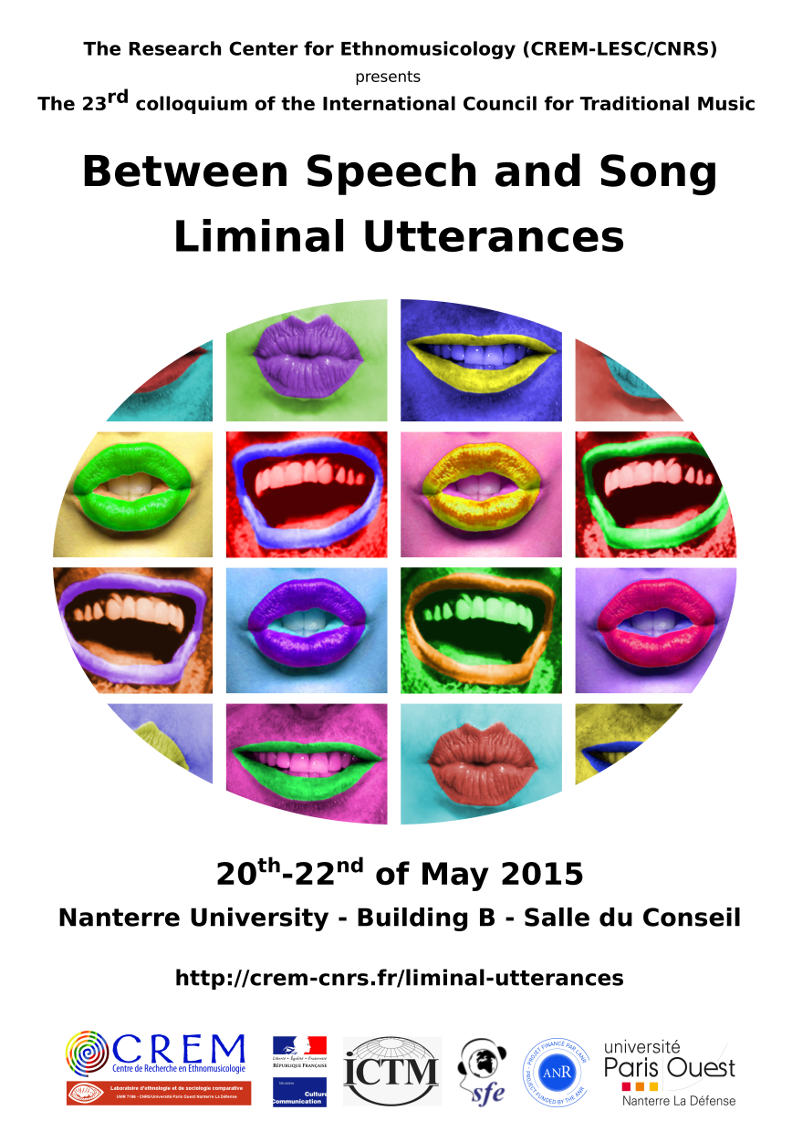 Proposé sous l’égide de l’International Council for Traditional Music (ICTM) et organisé par le Centre de recherche en ethnomusicologie (CREM-LESC/CNRS) à l’université Paris Ouest Nanterre la Défense, ce colloque permettra aux spécialistes des interactions vocales de débattre durant trois jours des questions et des pistes actuelles dans l’étude des énoncés liminaires. L’objet appelant par nature le croisement de plusieurs disciplines, les chercheurs invités, au nombre de vingt, proviennent de l’anthropologie, de l’ethnolinguistique, de l’ethnomusicologie, et de l’acoustique. S’y ajoutent des ingénieurs en traitement des archives et en analyse informatique du signal, qui travaillent actuellement à de nouveaux outils d’indexation des formes vocales.
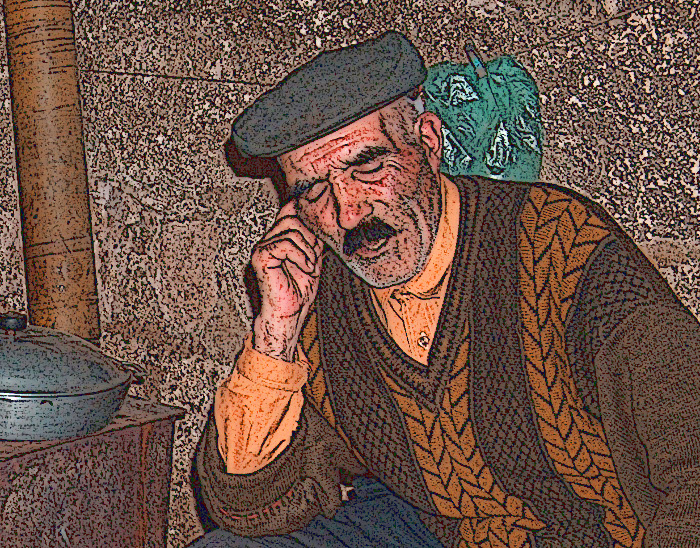 Comment caractériser la relation singulière que le langage entretient avec la voix ? Leur lien pouvait paraître évident avant le développement de l'écriture. Avec celle-ci cependant, une part significative de la communication linguistique peut se dérouler en dehors de la vocalité, et ce quelle que soit la langue considérée. De nombreux travaux en anthropologie et en linguistique ont par ailleurs montré que l’usage de voix dans le langage était perméable à d’autres manières d’utiliser l’appareil phonatoire. Décrits comme « chants », « cris », « lamentations », « psalmodies », « rires », « onomatopées » ou « idéophones », ces usages de la voix ont en commun d’entrer dans une dynamique complexe avec le langage articulé. Objets d’étude pour une part croissante de la communauté scientifique, ces énoncés liminaires interrogent également les ingénieurs et archivistes confrontés à la nécessité d’en catégoriser les documents sonores selon des critères stables et cohérents. En parallèle, l’étude pragmatique des interactions vocales rencontre d’autres cas-limite sous les traits de la glossolalie, du ventriloquisme, des voix « habitées » des médiums et des chamanes. Ces cas posent tous la question de la source d’animation du message, et de l’efficacité performative des énoncés en tant qu’actes vocaux.
Proposé sous l’égide de l’International Council for Traditional Music (ICTM) et organisé au Centre de recherche en ethnomusicologie (CREM-LESC/CNRS) à l’université Paris Ouest Nanterre la Défense, ce colloque permettra aux spécialistes des interactions vocales de débattre durant trois jours des questions et des pistes actuelles dans l’étude des énoncés liminaires. L’objet appelant par nature le croisement de plusieurs disciplines, les chercheurs invités, au nombre de vingt, proviennent de l’anthropologie, de l’ethnolinguistique, de l’ethnomusicologie, et de l’acoustique. S’y ajoutent des ingénieurs en traitement des archives et en analyse informatique du signal, qui travaillent actuellement à de nouveaux outils d’indexation des formes vocales.
http://archives.crem-cnrs.fr/archives/items/CNRSMH_I_2010_004_001_81/player/346x130/
La relation entre langage et musique a fait l’objet d’un long débat en ethnomusicologie. Le sujet a été soulevé dans l'article de List sur la frontière entre parole et chant (1963), dans les travaux de George Herzog sur la relation entre musique et texte (1934, 1942, 1950), et dans l'analyse du « discours musical » de John Blacking (1982). En une chaîne quasiment ininterrompue, différents travaux ont depuis précisé les données ethnographiques sur différentes pratiques vocales aux frontières entre langage et musique (lamentations, récitations et psalmodies, chants dont les paroles sont ou non compréhensibles pour les locuteurs).
En ethnolinguistique, des auteurs tels Laura Graham (1984, 1987), Ellen Basso (1985), Charles Briggs (1993), Jean-Jacques Nattiez (1999), et Aaron Fox (1992, 2004) ont analysé des modes d’énonciation où la forme vocale prend le pas sur le contenu sémantique (salutations rituelles ou incantations thérapeutiques par exemple), ou bien des formes d’interaction affectée par l’irruption d’énonciateurs non-humains (divinités, esprits, animaux) dans la voix des locuteurs. L’une des conclusions vers lesquelles ces travaux convergent est que la musicalité du discours est un aspect crucial, trop souvent négligé, ouvrant la voie à une description rigoureuse des croyances religieuses.
Très peu d'études ont cependant pris pour point de départ le lien étroit qui existe entre les dimensions sémantique et acoustique de la voix (voir Feld et Fox 1994). La fragmentation épistémologique du champ vocal entre linguistique, musicologie et anthropologie reste un obstacle de taille. Pour tenter de relever le défi, ce colloque portera précisément sur les énoncés liminaires situés à la frontière entre la voix parlée et chantée. Seront privilégiés des matériaux comme les lamentations, le babillage, les comptines, la récitation coranique, les narrations mélodisées et les contes chantés, le scat, la glossolalie, ainsi que l’usage et les variations de la voix dans la liturgie, le recours à l'iconicité du langage, ou encore à des jeux portant sur l'intonation dans les performances poétiques et les discours politiques. Au travers de ces études de cas, l’enjeu sera de croiser les analyses acoustique, sémantique et pragmatique des énoncés vocaux. Aux frontières de l’anthropologie, de l’ethnomusicologie, de la linguistique et de l’ingénierie, le colloque s’inscrit dans une perspective interdisciplinaire qui fera surgir de nouveaux objets.
23rd ICTM colloquium — organized by the CREM
The relation between speech and song is an old debate in ethnomusicology. The topic was notably addressed List’s important article on the boundaries of speech and song (1963), in George Herzog's early explorations of the relationship between music and text (1934, 1942, 1950), and in John Blacking's account of musical "discourse" (1982). Linguistically informed works addressed the question as well, such as that by Laura Graham (1984, 1987), Charles Briggs (1993), Jean-Jacques Nattiez (1999), and Aaron Fox (1992, 2004).But five decades after List’s foundational article, the topic continues to inspire discussion. The reason may be, as Anthony Seeger suggested, that the separation of disciplines that study different aspects of “vocal and verbal art has had a disastrous effect on the development of our thinking about them” (1986: 59). The wish to reconsider this separation has been pointed out for decades. This is particularly the case for studies focusing on liminal utterances, such as glossolalias or scat. Described by practitioners as an “event occurring in my throat” (Certeau 1996: 38), glossolalias are cases of vocal production without clear semantic meaning which multiplies the possibilities of speech. The decomposition of syllables and the combination of elementary sounds in games of alliteration create “an indefinite space outside of the jurisdiction of a language" (Certeau 1996: 42). In his study on scat, Brent Hayes Edwards (2002) also argues about an extended vocal space: a continuum between instrumental uses of the voice and vocal uses of instruments. In jazz, both are supposed to narrate stories.But still very few studies build their analysis on the intimate link between the semantics and acoustics of voice production. As pointed out by Steven Feld and Aaron Fox (1994), most studies in ethnomusicology have difficulties in simultaneously taking into account the words and sounds of vocal production, and combined analyses of the semantics and acoustics of vocal production are still very few and mostly unsatisfactory.
To try to take up this challenge, this colloquium will focus on liminal utterances, at the border between speech and song. We will consider utterances such as laments, nursery rhymes, Qur'anic chanting, recitative or the use of the monotone voice in liturgy, iconicity of language, scat, glossolalias, melodized narrations, sung tales, vocal intonation in poetical performances and in political discourses, among others. Special attention will be given to a deeply combined analysis of the acoustics and semantics of these utterances.
Références
BEAUDET Jean-Michel 1996 “Rire. Un exemple d'Amazonie”. L'Homme 36 (140): 81-99.
BLACKING John 1982 “The Structure of Musical Discourse: The Problem of the Song Text”. Yearbook for Traditional Music 14: 15‑23.
BRIGGS Charles L. 1993 “Personal Sentiments and Polyphonic Voices in Warao Women’s Ritual Wailing: Music and Poetics in a Critical and Collective Discourse”. American Anthropologist 95(4): 929‑957.
CERTEAU (DE) Michel 1996 “Vocal Utopias: Glossolalias”. Representations 56: 29‑47.
EDWARDS Brent Hayes 2002 “Louis Armstrong and the Syntax of Scat”. Critical Inquiry 28(3): 618‑649.
FELD Steven & FOX Aaron 1994 “Music and Language”. Annual Review of Anthropology 23: 25―53.
FOX Aaron 1992 “The Jukebox of History: Narratives of Loss and Desire in the Discourse of Country Music”. Popular Music 11(1): 53‑72.
2004 Real Country: Music and Language in Working-Class Culture. Durham, N.C. : Duke University Press.
GRAHAM Laura 1984 “Semanticity and Melody: Parameters of Contrast in Shavante Vocal Expression”. Latin American Music Review 5(2): 161‑185.
1987 “Three Modes of Shavante Vocal Expression: Wailing, Collective Singing, and Political Oratory”, in Sherzer & Urban dir.: Native South American Discourse. Berlin, New-York: Mouton de Gruyter: 83‑118.
HERZOG George 1934 “Speech-Melody and Primitive Music”. The Musical Quarterly 20(4): 452‑466.
1942 “The Text and Melody in Primitive Music”. Bulletin of the American Musicological Society 6: 10‑11.
1950 “Song”, in Leach dir.: Funk and Wagnalls Standart Dictionary of Folklore, Mythology and Legend. New-York: Funk and Wagnalls 2: 1032‑1050.
LIST George 1963 “The Boundaries of Speech and Song”. Ethnomusicology 7(1): 1‑16.
NATTIEZ Jean-Jacques 1999 Proust musicien. Paris : Christian Bourgeois éditeur.
SEEGER Anthony 1986 “Oratory Is Spoken, Myth Is Told, and Song Is Sung, But They Are All Music to My Ears”, in Sherzer & Urban dir.: Native South American Discourse. Berlin: Mouton de Gruyter: 59‑82.
Programme
Organizers
Coordination: Estelle AMY DE LA BRETÈQUE (CREM-LESC/CNRS, France)
Scientific committee
Bernd BRABEC DE MORI (University of Music and Performing Arts, Austria)
Junzo KAWADA (Kanagawa University, Japan)
Anthony SEEGER (UCLA, USA)
Kati SZEGO (Memorial University of Newfoundland - Executive Board member of ICTM, Canada)
Stephen WILD (Australian National University - Vice President of ICTM, Australia)
Local organization committee
Jean-Michel BEAUDET (UPO - CREM-LESC/CNRS)
Susanne FÜRNISS (MNHN/CNRS, president of the French Society for Ethnomusicology)
Andrea-Luz GUTIERREZ-CHOQUEVILCA (EPHE/LAS - Collège de France)
Giordano MARMONE (UPO, CREM-LESC/CNRS)
Magali De RUYTER (UPO, CREM-LESC/CNRS)
Victor A. STOICHITA (Director of the Research Center for Ethnomusicology – CREM-LESC/CNRS)
With additional help from: Loré Ajirent-Sagaspe, Éline Breton, Sisa Calapi, Preciosa Dombele, Laurence Lemaur (ethnomusicology students at UPO) and Iris Lemaître (student in Librarian Studies, UPO).
Partner institutions
The International Council for Traditional Music (ICTM) is a Non-Governmental Organisation in formal consultative relations with UNESCO. Its aims are to further the study, practice, documentation, preservation and dissemination of traditional music and dance of all countries. To these ends the Council organises World Conferences, Symposia and Colloquia. The Council also promotes these goals by publishing the Yearbook for Traditional Music, distributing the online Bulletin of the ICTM, and maintaining a rich Online Membership Directory. By means of its wide international representation and the activities of its Study Groups, the International Council for Traditional Music acts as a bond among peoples of different cultures.
The Research Center in Ethnomusicology (CREM) is heir to the former Ethnomusicology Department of the Musée de l’Homme (1929-2008), and has been part of the Research Team in Ethnology and Comparative Sociology (LESC – UMR 7186) since 2007. The CREM is dedicated to the study of musical practices and knowledge worldwide.
Based on ethnography and a systematic collection of musical data, its approach pertains to an anthropology of music conceived in its socio-cultural, aesthetic, formal, acoustic, kinesthetic and cognitive dimensions. The Center investigates new research topics such as the embodiment of musical and choreographic skills, the cultural and cognitive production of musical emotion, the interconnectedness of sensory modalities, the ecology of sonic environments, the construction and emergence of musical systems. Its researchers also create new modalities of musical representation, such as their “listening clues” (clés d’écoute) : these multimedia devices guide the general public towards crucial aspects of specific musical expressions.
The CREM manages a large collection of sound archives inherited from the Musée de l’Homme and accumulated over more than a century. With more than 4,000 hours of unpublished fieldwork recordings and about 4,000 hours of published documents, these archives of great patrimonial value are made available online through the collaborative platform Telemeta. The collections are constantly nourished through the researchers’ fieldwork. The recordings are used as materials for new research, as preparation for new fieldwork, and for the training of graduate students.
CREM researchers, lecturers and professors hold important responsibilities at the Anhropology department of Paris Ouest Nanterre – La Défense University, as well as at the Musicology Department of Paris 8 – St Denis University. Numerous graduate students from these universities are members of the CREM, which offers them a stimulating scientific and logistic environment.
The ANR project DIADEMS (Description, Indexation, et Accès aux Documents Ethnomusicologiques et Sonores) is a partnership between several teams dealing with acoustics, ethnolinguistics and ethnomusicological documents, and informaticians. The laboratory of Ethnology and Comparative Sociology (LESC) including the research center of ethnomusicology (CREM) and the center of teaching and research in American Indian ethnology (EREA) as well as the laboratory of anthropology of National Museum of Natural History (MNHN) are dealing with the need to index the audio archives they manage, while keeping track of the contents, which is a long, fastidious and expensive task. Since 2007, as no open-source application exists on the market to access the audio data recorded by researchers, the CREM-LESC, the LAM and the sound archives of the MNHN began the conception of an innovate and collaborative tool that answers the trade needs (linked to the documents temporal span), while being adapted to the researchers requirements.
With financial support from the CNRS Très Grand Equipement (TGE), ADONIS and the Mnistry of culture, the Telemeta platform, developed by Parisson, is online since May 2011 (http://archives.crem-cnrs.fr). On this platform, basic signal analysis tools are already available, It is however mandatory to have a set of advanced and innovative tools for automatic or semi-automatique indexing of this audio data, that includes sometimes long recordings, with quite heterogeneous content and quality. The aim of the DIADEMS project is to supply some of these tools, to integrate them into Telemeta, while also satisfying specific user needs related to ergonomy and accest rights management.
L'école doctorale « Milieux, cultures et sociétés du passé et du présent » associe un ensemble de disciplines : Archéologie, Ethnologie- Préhistoire-Ethnomusicologie, Géographie, Aménagement-urbanisme, Histoire, Histoire de l'Art, Langues et Lettres anciennes. Elle regroupe 9 équipes de recherche entre lesquelles se répartissent quelque 460 doctorants et 105 directeurs de thèse. Elle assure 3 missions au sein de l'Université : pédagogique — organisation des enseignements doctoraux et suivi des doctorants, soutien à la professionnalisation ; organisationnelle — budget, contrats doctoraux, a politique de financement des thèses mais aussi de veille au respect de la charte des thèses de l'université ; animation de la recherche — recherche de convergences entre les programmes des unités de recherche de manière à définir de grandes orientations thématiques.
La Société française d’ethnomusicologie (SFE) est une société savante dont la mission est d'encourager, de soutenir et de promouvoir la réflexion sur les musiques du monde. La SFE, est aussi un réseau d’experts, actifs au sein d’institutions comme l’Unesco, les musées, les festivals ou les médias (presse écrite, radios, TV, internet), qui contribuent ainsi à la connaissance et à la diffusion des expressions artistiques et culturelles de l’humanité. Elle est l’organe représentatif de l’ICTM en France.
Attending
Thanks to our partner institutions, attending the colloquium is entirely free for everyone.
Audience members (apart from staff and invited speakers) are welcome to share the collective meals, at their own expense.
Hotel
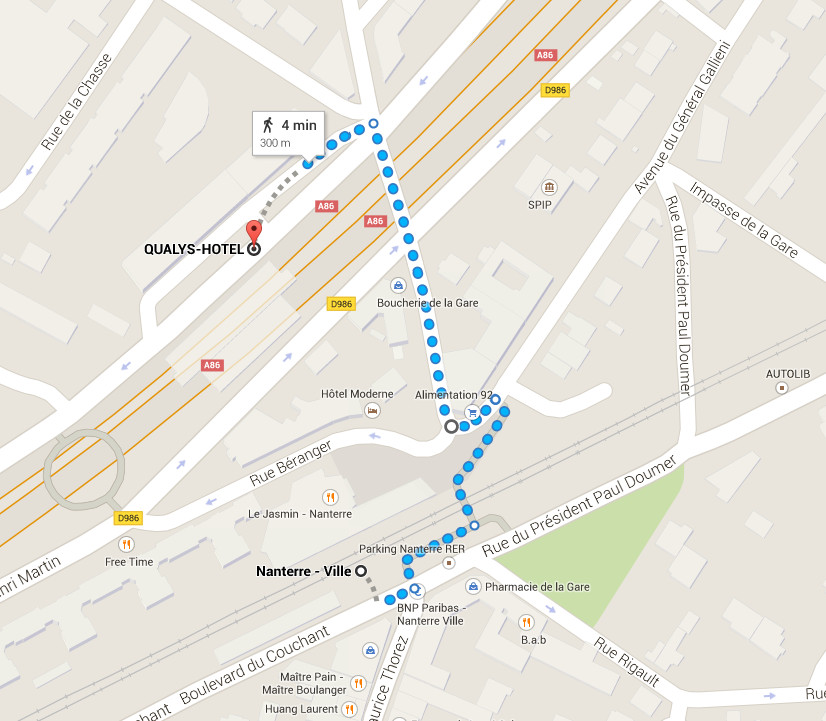
Invited participants are hosted at Hôtel Qualys Nanterre, 2, avenue Benoît Frachon 92000 Nanterre, Tel. 01 46 95 08 08.
The hotel is within a few minutes walk from the RER A stop "Nanterre Ville".
To plan your arrival, we suggest using the RATP route planner available here: http://www.ratp.fr/itineraires/en/ratp/recherche-avancee If you encounter any difficulties with the planner, please email us your travel details and we’ll check the best route for you.
Participants staying at the hotel will be provided upon their arrival with RER tickets for the daily commuting between the hotel and the university (1 stop).
It is also possible to walk the distance, should you prefer to do so.
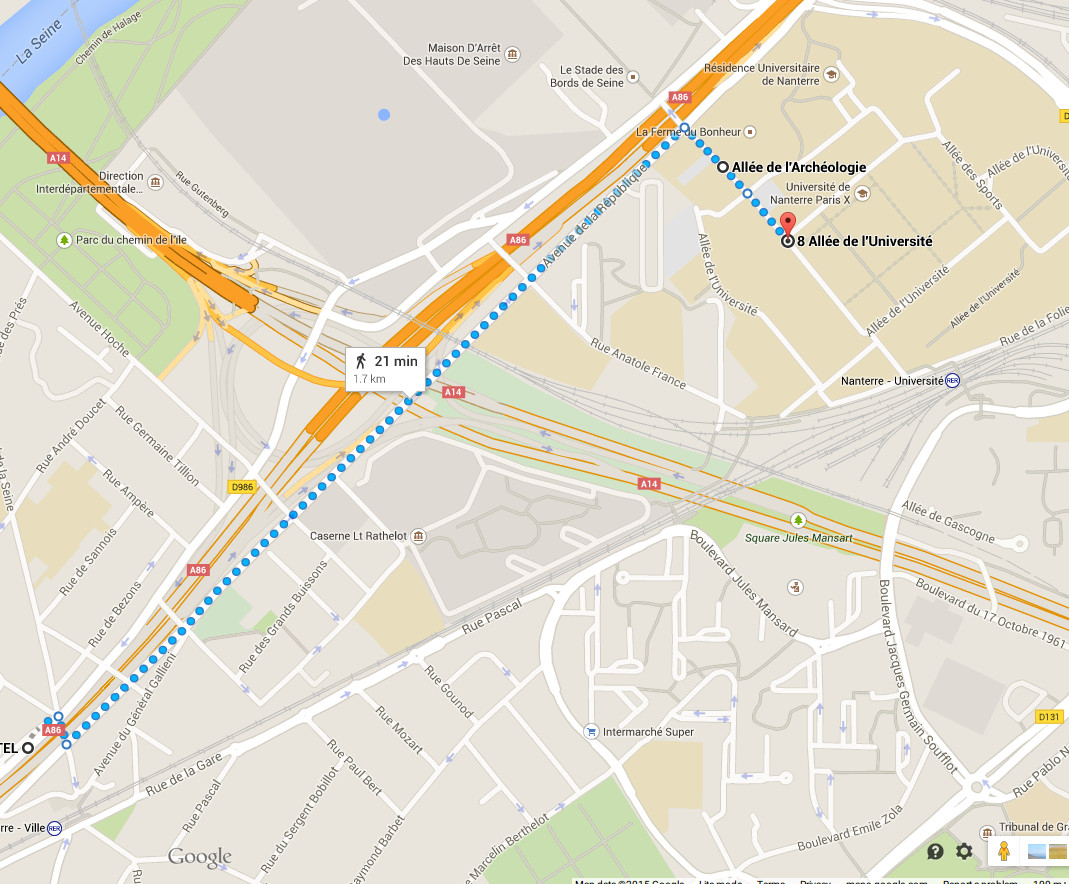
Easiest way to arrive, whether from Paris or from the hotel, is by RER A, stop "Nanterre Université". It is also possible to walk from the Hotel to the University (straight walk, ca. 20 min).
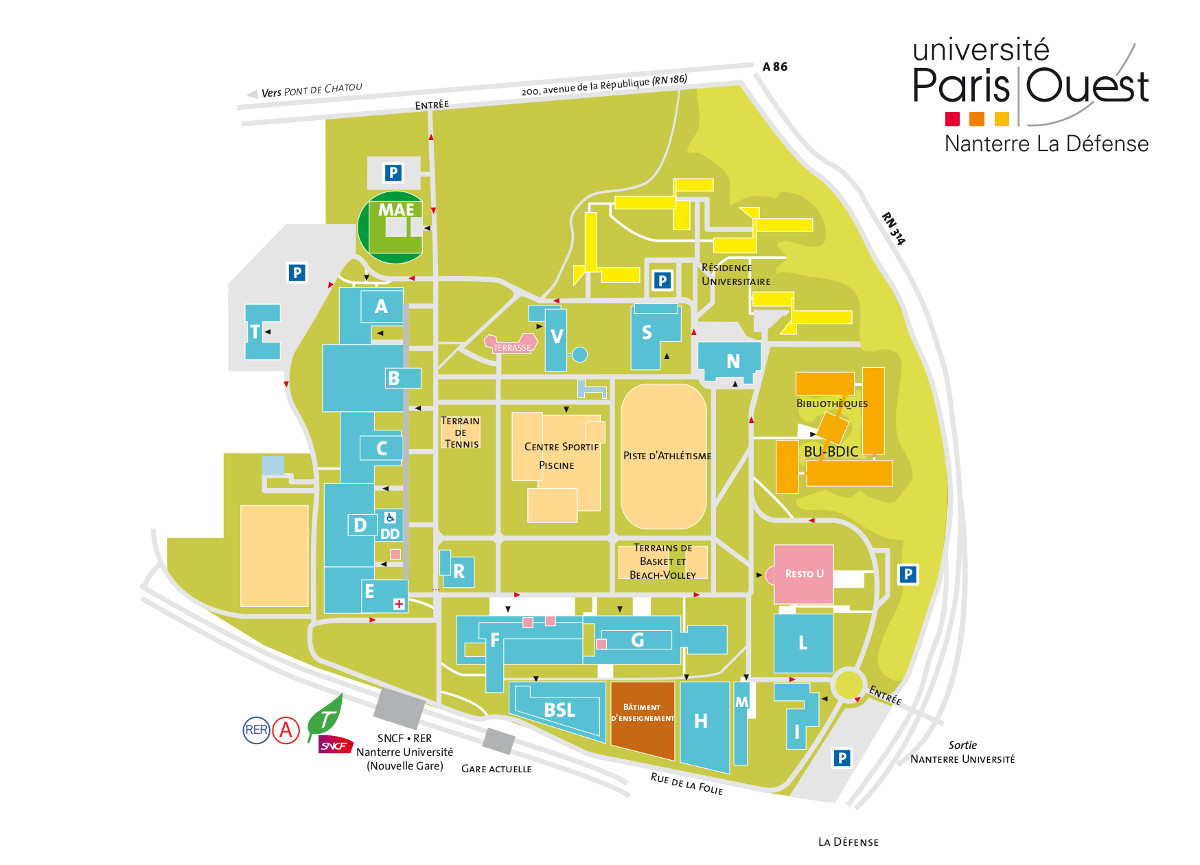
The colloquium takes place on the campus of Nanterre University, building B, Salle des Conférences. Below is a map of the campus.
Meals
Lunches will be served at the university’s restaurant on campus — the pink building on the map above, named Resto U.
Invited speakers arriving on the 19th afternoon are invited for dinner at Hotel Qualys.
Dinners and vocal workshops on 20th and 21st will take place at the "Ferme du Bonheur". This is just in front of the building marked "MAE" in green on the map (but it is not a component of the University, therefore it doesn’t appear on the map).
Farewell dinner on 22nd will take place at Flam’s restaurant in Paris (Rue des Lombardshttp://crem-cnrs.fr/plugins/system/jcemediabox/img/zoom-link.gif); background-color: transparent; display: inherit; background-position: right center; background-repeat: no-repeat no-repeat;">).
The intention of this colloquium on Liminal utterances is to discuss "hands on", with as many audio and video examples as possible. The Multimedia Presentations are an experiment in that direction. Presenters were invited to combine audiovisual data and analysis in order to produce a (more-or-less) self-standing video file containing an argument or simply raising questions about the illustrated sound practices. These files are available below. They will also be played during the conference, where each of them will be followed by extensive discussion sessions with their authors. Click on an image below to start a presentation (should open an popup with a HTML5 video).
Liminal utterances: multimedia presentations
Between Speech and Song: Liminal utterances of sadness in Anatolia and the Caucasus
 ESTELLE AMY DE LA BRETEQUE (CREM-LESC/CNRS, France)
This presentation explores the practice of melodized speech in the Caucasus and Anatolia. Taking as a case study the Yezidi Kurds in Armenia, it explains why this practice, linked to the narration of sad events, stands at the border between speech and song in the local typology of vocal production. On a wider area, the comparison of three case studies from fieldwork conducted in Azerbaijan, Turkey and Armenia shows how elderly women integrate melodized speech in daily conversations. Beyond religious, national and linguistic differences, the similarity of these practices suggests a shared social-vocal nexus in Anatolia and the Caucasus.
The vocality of a religious poem among the Pomaks
 EFTYCHIA DROUTSA (Iremus/University Paris 4 Sorbonne, France)
This work questions “vocality”, that is the sound production of speech and song among the Pomaks through their religious poem called mevlud.
Dating from the 15th century, the mevlud is a poem attributed to the poet Suleyman Çelebi, in which he relates the birth, the life and the death of the Prophète Mohamed. It is written in osmanli (Othoman, ancient Turkish in arabic characters) in the poetic form of masnavi, structured in a series of versified distiches where each verse adheres on a metric regularity of eleven syllables. We find this poem among Pomaks, a mountain population, muslim and trilingual, who speaktheir own Slavic dialect - Pomak -, Greek and Turkish. They live in the north of Greece in the area of Thrace and are recognized officially as “a religious minority” by the Greek Government. Pomaks learn to read the mevlud, on which they adapt a repetitive motif borrowed, modified and customized according to individual preferences and abilities. However, most of them do not understand the literal meaning of the poetic text. It is in this particular context, where the words are detached from their litteral meaning and become a medium for statement, that we will approach the duality of speech and song through a sound editing, where the words are sung, whispered, muttered, recited or simply said.
Development of turn taking in vocal interaction between mothers and infants aged between 2 and 4 months
 RUBIA INFANTI & EBRU YILMAZ (Laboratoire Ethologie, Cognition, Development -EA 3456-, University Paris-West, France)
Infants are known to engage in conversation-like exchanges from the end of the second month after birth. These ‘protoconversations’ involve both turn-taking and overlapping vocalization. Previous research has shown that the timing of adult-infant turn-taking sequences is close to that of adult verbal conversation. The gap between turns in protoconversational exchange seldom exceeds 500ms. It has also been shown that young infants adjust the quality of their vocalization in response to the quality and timing of adult vocalization. Furthermore, turn-taking exchanges often involve mutual imitation of sounds, pitches and melodic contour. We present new evidence of the timing and temporal organization of turn-taking interaction between mothers and 2 to 4-month-olds recorded in naturalistic contexts based on a corpus of recordings from 50 French dyads. All of them were recorded in naturalistic contexts, in their home, when infants were in a quiet alert state. The entire sample comprised a total of 2943 vocalizations of which 748 (25.4%) were produced by the infants, 1851 (62.9%) were produced by the mothers, and 344 were overlapping vocalizations (11.7%). In all, 489 turns taking sequences were identified. The quality and duration of infant vocalizations differed according to whether or not they were produced within a turn-taking sequence. Finally, length and number of turns were highly correlated between mothers and infants vocalizations.
[Coming soon…]
Sung assemblies or declaimed songs? The samburu soloists (Kenya) on the border between political discussion and musical activity
 GIORDANO MARMONE (CREM-LESC/University Paris West)
Among the Samburu of Kenya the leaders and the spokesmen of the warriors' age-grade, the so-called larikok, play a fundamental role in both political and musical domains. The oratorical skills of which they must be provided to protect the interests of the warriors during the assemblies, core of the Samburu political system, also allow them to stand out as main soloists during the singing and dancing
Ferdinand Brunot and the Archives de la Parole
 FRANÇOIS PICARD (Iremus, University Paris 4 Sorbonne, France)
The Archives de la Parole or Spoken Archives have been founded by the French historian of French language and grammarian Ferdinand Brunot at Sorbonne university in 1911. Using a Pathéphone phonograph, he recorded spoken or singing voices, he classified in main sections: I for “interprètes”, O for “orateurs”, L for «langues”, D for “dialectes”. Taking it as a solid corpus, we analyse it using digital tools according to the relation between pitch, intensity and timbre, and find it possible through strong descriptors to recover local, culturally meaningful, categories. The question of whether this new categorisation could be universal will be asked.sessions. This double form of authority is based on what, among the Samburu, is considered as one of the essential features of male leadership: the ability of “dominating the words” in all their forms, both sung and spoken. At the same time, this connection between political debate and soloist singing is not focused exclusively on the double social role of the larikok. The vocal technique that characterizes a big part of the Samburu's musical repertoire, in fact, is definable as a form of speech shaped around the rhythm of the dance. It confers to the melodic contour of the soloist's part the prosodic characteristics of the spoken language, making Samburu choral songs a sort of oratorical confrontation between soloists, very close, structurally and verbally, to the assemblies' debate scheme. The process of decision-making and the composition of the songs' lyrics lead, in both cases, to the creation of accounts which aim to expose opinions and stories based on real events. But if during the assemblies the speakers' purpose is to use their own charisma for the political administration of the community as representatives of an age-grade's or an age-set's interests, during the singing and dancing sessions the soloists have the responsibility to stand for their age-group and share with the listeners the narrative of its collective memory, contributing to assert its presence within the society.